Beginner Series: 15-Minute Core Workout (Emphasis on Obliques)

beginner-core-workout-at-homeChronic back pain, poor posture, improper form when doing low-body and arm exercises—all can be improved by strengthening your core. This workout would be a great one to combine with a longer cardio session or to do on a more restful day before/after a yoga class. I mean to imply that it’s easy; it’s simply quick and targeted.

Just like last week’s workout in the beginner series, don’t count it out if you’re a little more advanced. Just as there are always ways to modify exercises, there are also ways to advance them.

Beginner Series: 15-Minute Core Workout (Emphasis on Obliques)

Equipment I Used:

  • One medium weight (I would suggest 8-10lbs for true beginners, but use a weight that challenges you!)
  • Gymboss Interval Timer (there are lots of interval timer apps available for smart phones, too!)
  • Exercise mat
  • Pen & paper for recording rep numbers.

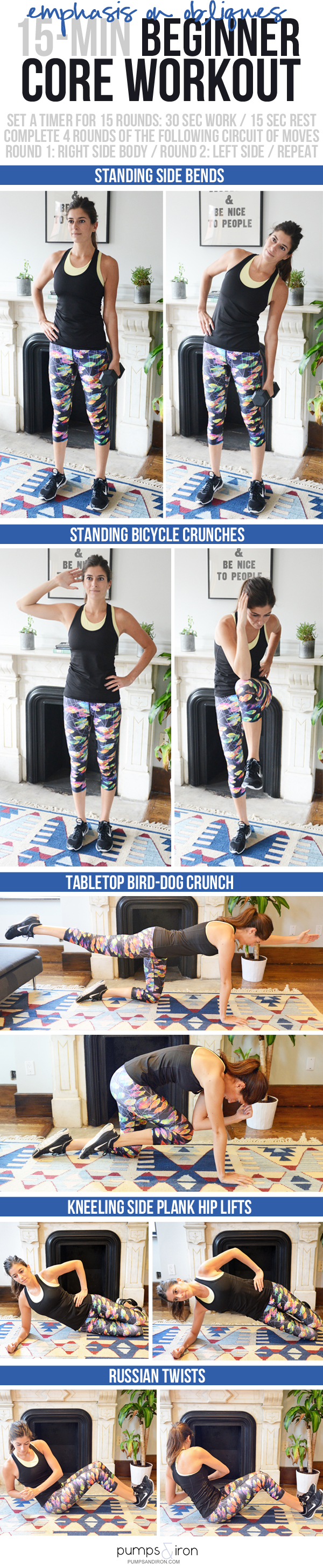
Set an interval timer for 20 rounds of 30 seconds of work and 15 seconds of rest. You’ll go through the following circuit of five exercises four times. Focus on one side of your body per round. In other words, your first time through the circuit, every exercise should be done on the right side. The second time through, do them all on the left. The only exception to this is the russian twist, which will target both sides of your body every time you preform it.

At the end of each work interval, write down the number of reps you were able to complete of the exercise in the 30 seconds. Do this for each round. As you tire toward the end of the workout, challenge yourself to stay within a couple reps of what you got the first time through. Here are some rep goals so you have an idea of what to shoot for:

target-rep-numbers-core

Don’t get hung up on these rep numbers. They’re to motivate and challenge you, not to discourage you. Do the best you can do, and next time you try this workout, focus on improving from your previous numbers. Never sacrifice proper form to get high numbers. Beginner Core Workout (emphasis on obliques) - this will take you just 15 minutes and includes detailed exercise descriptions with ways to modify and advance each move
Standing Side Bend

Stand with feet hip distance apart and a weight in one hand, other hand on hip. I typically use a 25-lb kettlebell for these. A 10-lb dumbbell is a great place to start, and for true beginners, you might even want to start lighter. Lean over to the side with your torso as you lower the weight towards the ground (try to get it at least to knee height, if not a little lower). Engaging the obliques, bring your torso back upright to starting position once you’ve gone as low as possible. That’s one rep.

Make sure that you’re bending to the side—not leaning forward or backward at an angle as you dip. Envision sliding the weight down the side of your leg to keep this alignment.

MAKE IT EASIER

  • Use less weight.
  • Perform the move seated, on either a bench or chair without arms.

MAKE IT HARDER

  • Use a heavier weight.
  • Extend the other hand overhead as you bend to the side.

Beginner Core Workout (emphasis on obliques) - this will take you just 15 minutes and includes detailed exercise descriptions with ways to modify and advance each move

Standing Bicycle Crunches

Start standing with feet hip’s width apart, one hand on your hip and the other lightly behind your head. Don’t pull on the back of your head; keep your chest open, roll the shoulderblade back and down and squeeze your upper back to maintain this wide elbow placement. From this starting position, your going to crunch that elbow down and across your body to touch the opposite knee, which you’ll bend and lift up towards it, squeezing your low abs. Don’t worry if you can’t make physical contact between the knee and elbow; focus on pulling you core in tight (like someone is punching you in the stomach) and just get them as close as possible. Carefully return to your starting position. That’s one rep.

MAKE IT EASIER

  • This one requires balance. If it’s too much, hold onto something with your bottom, non-crunching hand to steady yourself as you perform the exercise.

Beginner Core Workout (emphasis on obliques) - this will take you just 15 minutes and includes detailed exercise descriptions with ways to modify and advance each move

MAKE IT HARDER

  • Do it laying on the floor. Lay on your back like a traditional bicycle crunch, peeling your shoulders off the ground as you crunch up to meet the opposite knee. If you take this advancement, still crunch to the same side during a 30-sec work period, alternating each time through the circuit.

Tabletop Bird Dog Crunch

Start in a kneeling tabletop position with hands stacked directly under shoulders and knees under hips. Contract your abs to stabilize you as you outstretch your right arm in front of you and your left leg straight behind you. The extended limbs should be level with your hips/shoulders. This is your starting position. From here, bend the extended limbs, crunching the elbow in towards the knee. As you do this crunch, picture someone punching you in the stomach—contract the abs and round the spine up towards the ceiling, pulling the core in tight. Return to starting position, extending the right arm and left leg back out. That’s one rep.

Important form focus: Pay attention to your back—it should never sag down toward the ground. Look in a mirror when you’re in tabletop with your leg and opposite arm outstretched. Does your back look like a hammock hanging between your bum and shoulders? That’s not what you want; it probably means you aren’t engaging your abs. Think of pulling your bellybutton in towards your spine. Aside from the natural curvature of the spine, your back should be flat while in this starting position.

MAKE IT EASIER

  • Keep both hands on the ground. If you’re feeling too wobbly during the move, keep both hands planted firmly on the floor and just focus on crunching the knee in as you squeeze your abs.
  • You’ll notice this is a recurring modification: If floor exercises don’t work for you because of limited mobility, bring the “floor” up to you. Instead of being on all fours, find a plank position on an elevated surface (bench, coffee table, etc.). Perform your crunches from here, possibly just crunching the knees in one at a time if incorporating the upper body isn’t working.

Beginner Core Workout (emphasis on obliques) - this will take you just 15 minutes and includes detailed exercise descriptions with ways to modify and advance each move

MAKE IT HARDER

  • Hover your knee. Instead of having your non-crunching knee on the ground, plant the ball of that foot onto the floor and lift the knee up a couple inches so that it’s hovering (otherwise your body is in the exact same position). You’ll feel that quad start to burn as it works to stabilize you through the crunches.
  • Do it in a plank. Instead of having your knees on the ground, hold a full plank position (balls of feet on the floor) as you crunch opposite knee to elbow.

Kneeling Side Forearm Plank Hip Lifts

Laying on your right side on the floor, plant your right forearm on the ground with the elbow stacked directly under the shoulder. Stack your left knee on top of the right. From here, contract your right sidebody as you lift your hips off the ground so that your bottom knee and forearm are now your points of contact with the floor. Pause at the top, really squeezing into the sidebody and pressing the hips as high as they’ll go. Slowly lower the hips back down to the ground. That’s one rep. 

MAKE IT EASIER

  • If limited mobility prevents you from doing floor exercises, put your bottom forearm on an elevated surface (bench, table) instead (feet will be on the floor instead of knees if you take this modification). From this incline side plank position, lift and lower your hips.

MAKE IT HARDER

  • Don’t rest your hips on the ground at the end of each rep. Lower them to a hover then contract the obliques to lift ‘em right back up.
  • Do it from your feet. Instead of having your knees be the point of contact with the floor, do these in a full plank position, feet stacked on the floor.

Beginner Core Workout (emphasis on obliques) - this will take you just 15 minutes and includes detailed exercise descriptions with ways to modify and advance each move

Russian Twists

Start seated with knees bent and heels planted on the ground. Lean back slightly (don’t slouch, keep your chest open) until you feel your abs sort of kick in and start working to support the angle of your torso. From this starting position, twist to one side, bringing your hands to the outer side of that hip; then repeat in the other direction. That’s one rep. Really twist at the waist—you want your chest to be totally facing whatever side you’re bringing your hands.

MAKE IT EASIER

  • Sit in a chair instead of on the floor. If you have limited mobility, getting all the way down to the floor for exercises can be really challenging. Don’t let that discourage you! Bring the “floor” up to you. Sit in a chair without arms and scoot forward enough on the seat so that you can still lean back slightly with your torso. Twist side to side from here. Since this will be easier than the floor, maybe you try holding a weight while you twist to keep the challenge. 

MAKE IT HARDER

  • Hold a weight in your hands as you do this.
  • Lift your feet off the ground. Instead of having your heels down for support, balance on your tailbone, hovering the feet off the floor as you twist side to side.

beBeginner Core Workout (emphasis on obliques) - this will take you just 15 minutes and includes detailed exercise descriptions with ways to modify and advance each moveginner-core-workout-5

The “Why” Behind This Workout

A strong core makes for a strong body. As your core strength improves, you’ll notice that you’re better able to perform low body and upper body exercises with proper form. So much of our ability to balance and move with coordination comes from having a strong core—after all, it’s where all our limbs are attached!

Speaking of this powerhouse muscle group …

It’s important to train all sides of your core, not just the “six pack.” Your core includes your obliques, back and all the connecting muscles. It’s important to move away from crunches and make sure you’re working your sides and backside in addition to the front. Think of your core as a girdle: If only the front side is strong, it’s not very effective at holding everything in, now is it?

Focusing on one side at a time is a challenging and effective way to train. By spending an entire circuit on the right sidebody before doing the whole circuit on the left will effectively work the targeted muscle group to its point of exhaustion. It’s the methodology used in Lagree Fitness (the megaformer class I teach), and I find it to be so effective and challenging.

Moving gradually from standing to floor moves makes the transitions easier for people with joint issues or who are carrying a significant amount of extra bodyweight. While some of these exercises are done on the floor, I’ve included modifications for staying a little higher up for all. One of the biggest challenges a beginner may face is all the fast position changes that often come with workouts: hopping from laying on your stomach to your feet; jumping from plank to a squat; getting up and down from the floor—it’s not always very joint friendly. This workout moves from standing, gradually down to the floor so that you only have to get down (and then back up) once per circuit round.

Interval training is effective and gives you a way to track improvement (counting reps). Interval training improves your body’s ability to recover (with respect to cardiovascular and muscular recovery). The first time you do this workout, you might find your rep numbers dramatically dropping with each round because the 20 seconds of rest time won’t feel long enough toward the end. If you continue to incorporate this type of training into your workout routine, you’ll find your body becomes better able to recover from the cardiovascular and muscular strain of the work intervals, improving your performance (especially in those later rounds!). This will be reflected in steadier (and higher!) rep counts.

Beginner Core Workout (emphasis on obliques) - this will take you just 15 minutes and includes detailed exercise descriptions with ways to modify and advance each move

WEARING | leggings: Zara Terez c/o Bombas (<– the comfy socks I’m wearing!) // tank: H&M (old but similar HERE) // sports bra: (old but similar HERE) // sneakers: Nike

SHOT in a Breather room (Gloucester St. #2) — I always get lots of questions about where the decor is from and unfortunately have no clue (although I wish this was my apartment haha). You can get your first hour of Breather free with code PUMPIRON (they’re in NYC, Boston, San Fran, Montreal & Ottawa).

As always, let me know if you have any questions on form in the comments! I’ll do my best to answer quickly.

MORE RESOUCES FOR BEGINNERS: 

signature

SHOP A SIMILAR LOOK:

Beginner Series: 20-Minute Full-Body Workout with Cardio

Beginner Workout - 20 minutes, full-body, little to no equipment required, and perfect for doing at homeWhere my newbies at??! Today’s (and the five Tuesdays’) post is for you. I’m going to get super detailed with exercise breakdowns, modifications, and ways to make everything harder when you’re ready to take it up a notch. We’re going to focus on foundational movements (squat, lunge, push up, etc.) and mix in a little cardio. Even if you’re not a beginner, you could always advance the exercises and get a great workout in! I’ll go over all that.

Beginner Series: 20-Minute Full-Body Workout with Cardio

Equipment I Used:

  • Light set of weights (optional)
  • Chair
  • Gymboss Interval Timer (there are lots of interval timer apps available for smart phones, too!)
  • Pen & paper for recording rep numbers.

Set an interval timer for 20 rounds of 40 seconds of work and 20 seconds of rest. You’ll go through the following circuit of five exercises four times. At the end of each work interval, write down the number of reps you were able to complete of the exercise in the 40 seconds. Do this for each round. As you tire toward the end of the workout, challenge yourself to stay within a couple reps of what you got the first time through. Here are some rep goals so you have an idea of what to shoot for: target-rep-numbers

Don’t get hung up on these rep numbers. They’re to motivate and challenge you, not to discourage you. Do the best you can do, and next time you try this workout, focus on improving from your previous numbers. Never sacrifice proper form to get high numbers.Beginner Workout - 20 minutes, full-body, little to no equipment required, and perfect for doing at home

Squat, Stand and Press

Start seated in a chair with knees bent at a 90-degree angle and feet flat on the floor. Sit upright (shoulder blades rolled down and back, tailbone tucked and core engaged) and hold two dumbbells at your shoulders. I’m using 10-lb dumbbells here, but I’d recommend 5-8 lbs to start. If you’re a true beginner, don’t use any weights. Master the movement and then grab some dumbbells.

From this starting position, hinge forward slightly from your hips, shifting your weight into your heels as you begin to stand. Activate your glutes and press your hips forward as you stand upright. From here, press the weights overhead, making sure not to shrug your shoulders up toward your ears as you do.

Reverse the movement: Lower the weights to shoulder height and begin to squat down, sliding your hips and bum back as you bend your knees and lower to a seated position in the chair. That’s one rep.

MAKE IT EASIER

  • Ditch the weights. Just do bodyweight squats into the chair and when you stand back up, reach overhead.

MAKE IT HARDER

  • Use heavier weights.
  • Ditch the chair. Squat down low, still sending your hips and bum back and down as if there were a chair seat to catch you, and then power up, squeezing your glutes and pushing your hips forward to a standing position.
  • Make it explosive. Instead of breaking it into two movements (squat then press), initiate the overhead press as you power up from the bottom of your squat. Only do this once you’re comfortable squatting without a chair.

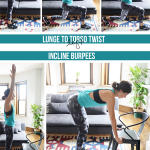
Lunge to Torso Twist

Start standing with arms held straight in front of you. From there, lunge forward, stepping your right foot in front of you as you bend both knees to opposing 90-degree angles. Holding this low lunge, twist your torso to the right, keeping arms straight as you do (you always twist over the front leg). You want your whole upper half moving as one unit on this—imagine your waist is a wet towel that you’re wringing out as you twist. Reverse the sequence, twisting back to center and pushing off that front right foot to return back up to standing. That’s one rep.

MAKE IT EASIER

  • Hold on to a chair with your left hand as you do it to help with balance.

Beginner Workout - 20 minutes, full-body, little to no equipment required, and perfect for doing at home-lunge-modification

MAKE IT HARDER

  • Hold a dumbbell in your hands as you do this (you’d still keep arms outstretched and straight).

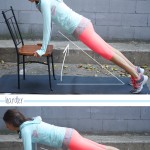
Incline Burpee

Changing the angle of your body can make exercises harder or easier, so this is just a modified version of your standard burpee. Start standing in front of a chair or bench (bench/flat surface is best), feet about shoulder-width apart and arms overhead. Swoop down, bringing your hands to the chair and planting them firmly underneath your shoulders. Jump both feet back into an incline plank position. Do a push up, lowering your chest towards the chair seat/bench and keeping your body in that straight plank position. It doesn’t have to be a full push up; if you’re a true beginner, even just lowering a couple inches and then pressing back up to plank is a great place to start. Jump your feet back up by the chair and stand upright, bringing your arms overhead to your starting position. That’s one rep.

MAKE IT EASIER

  • Eliminate the push up.
  • Instead of jumping your feet back into plank, step them one at a time.

beginner-at-home-full-body-workout-14

MAKE IT HARDER

  • Jump up in the air to finish each rep instead of just standing upright.
  • Use a lower chair/bench (or bring your hands all the way down to the ground!).

Jumping Jacks

Chances are you don’t need a written description of a good ol’ jumping jack, but I’m doing it anyway. Start standing with your feet a couple inches apart and your arms down by your sides. Keeping your knees soft (we never lock out the knees when doing a jumping move–think of landing softly), jump your feet out wide as your swing your hands out wide and up overhead. Immediately jump your feet back together as your hands come back down by your sides. That’s one rep.

LOW-IMPACT OPTION: Jumping might not be in the picture right now. For a low(er)-impact alternative, march in place instead of doing the jumping jacks. Pump your arms as you drive one knee at a time up into the air, engaging your core as you do.Beginner Workout - 20 minutes, full-body, little to no equipment required, and perfect for doing at home

The “Why” Behind This Workout

I told you I was going to get detailed in these posts. I really do think that for beginners, learning about exercise is just as important as the actual exercise–knowledge is power, baby!

Using a chair will help you master proper squat form. One of the biggest form errors with squats is sticking your knees out farther than your toes instead of sitting back into the position as you lower. Having the seat of a chair to catch your bum will get you comfortable with sliding your hips back, shifting your weight into your heels, and keeping those knees stacked over your ankles.

Mixing in some single-leg work (lunges) improves balance. Fitness isn’t just about your body’s strength; you have to work on improving range of motion (flexibility), agility and balance, cardiovascular endurance, etc. All these factors work together, and improving one will help improve the others.

Foundational exercises improve your body’s ability to function in everyday life. The key word with movements like squats, lunges, overhead presses and burpees is functional. These are all movements you do in everyday life! Sitting down in a chair; getting up from a seated position; bending down to pick something off the floor; lifting things above your head to put them on a top shelf; walking up the stairs–the list goes on.

Interval training is effective and gives you a way to track improvement (counting reps). Interval training improves your body’s ability to recover (with respect to cardiovascular and muscular recovery). The first time you do this workout, you might find your rep numbers dramatically dropping with each round because the 20 seconds of rest time won’t feel long enough toward the end. If you continue to incorporate this type of training into your workout routine, you’ll find your body becomes better able to recover from the cardiovascular and muscular strain of the work intervals, improving your performance (especially in those later rounds!). This will be reflected in steadier (and higher!) rep counts. Beginner Workout - 20 minutes, full-body, little to no equipment required, and perfect for doing at home

WEARING | tank: Alo Yoga c/o Carbon38 // leggings: Zara Terez c/o Carbon38 // sports bra: Nike c/o Kohl’s // sneakers: Nike

SHOT in a Breather room (Gloucester St #2) — you can get an hour of room rental time fo’ free if you sign up using the code PUMPIRON

Alrighty, I’ll have another beginner workout for you next Tuesday! You can look forward to an upper body workout, lower body workout, two core workouts and a cardio workout. Happy sweating!

signature

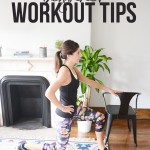
Workout Tips for Beginners

Workout Tips for BeginnersAs I mentioned in a post last week, I’m going to dedicate every Tuesday for the following month or so to beginner workouts. I figured it be helpful to kick it off with some general tips for those just starting out with a fitness regimen. Everyone’s starting place is different, so I’m basing these tips off the most common challenges I see beginners face during workouts. They may or may not apply to you.

I want to emphasize that nothing replaces working with a professional in person when you’re a beginner. Going to the gym/studio can be intimidating when you’re just starting out, but working 1-on-1 with a trainer, or even attending a class where you can get some personalized attention from a group fit instructor, is very helpful. I do my best via the internet to make your at-home workouts safe and effective, but it can’t replace having a pro there with you in person to check your form and create individualized routines. Ok obligatory safety disclosure aside, let’s get to the good stuff! 😉

Workout Tips for Beginners

The biggest changes don’t come from working out; they come from improving your diet.

This isn’t technically a workout tip, but it’s so important for everyone to understand that all the sweating in the world can’t undo the damage of an unhealthy diet. If Person A eats healthy in reasonable portions and doesn’t workout and Person B overeats and eats unhealthily but hits the gym for an hour a day, I guarantee you that Person A is the overall healthier human (and probably looks it, too).

Before you add in impact, you want to make sure you have a good stable base and your form down pat.

In other words, skip the jumping at first. Instead of jump squats, just do regular squats until you’re comfortable with the form. If stepping into low positions (lunges, etc.) also feels too difficult, try holding onto a rail or chair as you do these moves so that you can stabilize and support some of your bodyweight. Always start in a stable environment before slowly incorporating instability to challenge you (single-leg moves, stability balls, etc.).

Use a mirror!

If you’re working with a trainer or taking a group fitness class, you have someone else with their eyes on you, but if you’re at home, it’s up to you to keep your form in check. Sometimes things feel correct, but when you see yourself in action it’s like oh jeeze, that is not how it’s done. I still have these moments all the time when I’m looking at pictures I’ve shot for the blog, and it’s been a huge help in correcting my form. Even if you don’t do the entire workout in front of a mirror, practice each exercise in front of one.

If mobility is an issue, use an elevated surface instead of the floor.

Push ups, burpees, mountain climbers—any exercise that calls for you to bring your hands to the ground can be made easier by bringing the “ground” closer to you. Especially if you have a history of knee issues or a significant amount of weight to lose, moving quickly from standing positions to floor positions can be extremely difficult. If you bring your hands to bench instead, you wont’ have to bend down as low and the inclined angle will make the exercise more manageable.

Speaking of mobility, don’t forget to stretch!

Being fit isn’t just about strength and cardio. You want an unhindered range of motion so that you can effectively perform various exercises. What we think of as traditional stretching (holding a static stretch for 30 seconds) should be done after a workout. Before working out, focus on active moving stretches (arm circles, hip circles, etc.). SMR (foam rolling) can be used before and after a workout. If you have a particularly tight area that will limit your range of motion during a workout, it can be helpful to target it beforehand. Personally, the majority of my foam rolling is done post-workout and/or before bed.

Warm up.

Don’t jump right into a workout, especially if you’ve spent the rest of your day up until then being relatively sedentary. Active stretching, SMR if necessary, and then 5-10 minutes of light cardio (power walk around the block, jog on a treadmill, hit up the stairmaster, ect.) should do the trick.

Recovery is necessary for growth—don’t neglect rest days.

It’s not uncommon to start seeing results and then almost get anxiety at the thought of missing a workout because you don’t want that progress to stop. And it’s understandable—there’s a good reason exercise is addictive! It makes you happy, energized, enabled, empowered and attractive. But remember, you’re doing this to help your body function at its best, not punish it. Your body needs time to repair itself so that your workouts will continue to be effective—you might actually notice a stall in progress if you over-train. Again, everyone is different, but here’s some general rest advice: Take one true rest day a week, and another easier day where maybe you just do some light yoga and go for a long walk.

Be excited, not discouraged!

I’m not just trying to be nice and make you feel better—being a beginner is the best. I know it can feel overwhelming because you have so far to go, but often the biggest and fastest progressions happen when you’re at ground zero. Every workout brings a challenge and a change.

Other helpful posts for beginners:

Fellow instructors and trainers—what additional advice would you give to a beginner?

signature