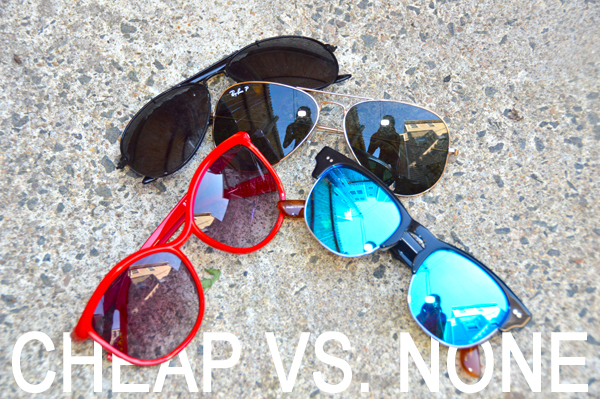
 I was flipping through this month’s Shape and saw an interesting little factoid: It’s better for your eyes to wear no sunglasses than cheap sunglasses. As a huge fan of cheapies (expensive sunglasses are cursed—I lose/break them all the time!), I had to do some research of my own on the cheap vs. none issue.
Turns out, Shape is right—if the lenses of the cheap sunglasses don’t offer 100% UV protection. The dark lenses will cause your pupils to dilate, letting in more harmful UV rays than if you wore no sunglasses and squinted with tiny pupils. However, lots of cheap sunglasses do offer 100% UV protection, and therefore are way better than going without. Lens quality (= price of the glasses) and UV protection offered aren’t always one in the same. Read labels, and when in doubt, any optometrist can easily test the UV protection offered by lenses (not that I would ever go through the hassle of getting a pair of $10 drugstore sunglasses tested by my eye doctor haha).
You want lenses that provide 100% UV protection, or UV 400 protection. These mean both UVA and UVB radiation will be absorbed by the lenses and blocked from your eyes.

This is what happens when I spend more than $25 on sunglasses…I’m cursed!!
I learned some other fun facts about sunglasses and eye protection in all the articles I read that I thought would be fun to share with you guys. Gotta love the internet, right?? One minute I’m Googling “cheap sunglasses,” the next I’m basically a licensed optometrist. 🙂
Lens color & tint don’t matter.
Color and tint may change the brightness, contrast and perception of color, but are not indicative of the UV protection. For example, clear prescription glasses with 100% UV protection are actually a million times better for your eyes than black lenses without UV protection. You’ll squint, but at least you won’t give your eyes a sunburn.
Lens material can be indicative of UV protection offered.
Check what the sunglasses lenses are made of:
- CR-39R plastic = roughly 88% of UV light is absorbed
- Polycarbonate = 100% UV light is absorbed (common in expensive sunglasses)
- Triacetate = 40% of UV light is absorbed (common in cheap sunglasses)
Sunglasses sold in the US are regulated by the Food and Drug Administration using ANSI (American National Standards Institute) ratings.
The FDA?? This one surprised me. They essentially require sunglasses to have “acceptable” UVA and UVB protection levels (these are less than 100% UV protection) and pass an impact test. This is the ANSI Z80.3-2001 standard.
Speaking of standards, if your sunglasses have a CE marking on them, that means the product meets requirements set by the European Union. For sunglasses, this means a certain level of UV protection that, again, is less than 100%. Bottom line, don’t use these standards as your only determining factor when buying sunglasses!
Do you go for the pair of expensive sunglasses or stick to cheapies?

Where I got most of my info: 1, 2, 3
 Hey there! I'm Nicole, a group fitness instructor, healthy lifestyle blogger (you probably figured that one out by now) and Certified Personal Trainer living in Boston, MA.


This is very informative, I didn’t imagine cheap sunglasses could be bad for my eyes. I’ll definitely be more careful when making purchases!
I shattered one lens of my aviator Ray Bans and they are at a local sun glass shop is replacing the lens form me .. much cheaper than a new pair.
Monica
Definitely! And Ray-Ban aviators are such an awesome, classic pair of sunglasses–totally worth it to get them repaired! 🙂
Check out fuselenses.com to replace the lenses in your RayBans!!!
Very interesting!! I stick with my cheapies. I have a family member who always has $300 Gucci sunglasses and loses them. So I refuse to spend more than $10.
http://neatly-packaged.blogspot.com/
I paid full price for one pair of designer shades…my friend sat on them a week later. Never again! It’s the sale rack from here on out haha
I have the curse as well — I always buy cheap-o sunglasses! I usually do look for it to say somewhere that there is 100% UV protection, even though I don’t like spending a lot. I’m assuming they can’t lie to you, right? haha
I would hope! That might call for some more online investigation haha
I usually end up buying mine at TJMaxx or Marshall’s. Semi non cheap glasses for the price of sunglasses at Target. I find most of them there are 100% UV protection.
I LOVE TJMaxx! I’ve found some awesome sunglasses markdowns at Nordstrom Rack, too.
Very helpful! I never knew this!
roseylittleme.blogspot.com
I used to buy expensive ones, and they broke all the time, then I started buying cheap ones, but I kept feeling nauseous and a few other side effects, so I went back to expensive ones, but I’ve found that the sports companies like Oakley or Spy or Smith, etc. make awesome non-shatter sunglasses that are still very fashionable! So, that’s what I wear now 🙂 I stay away from the “Chanel’s”, etc. No bueno.
Yikes–nauseous from cheapies? Who knew they could make such a difference!
I’m an expensive sunglass girl or sure, but I take very good care of them!
xo
http://www.style-wire.com
Oh wow, very interesting! I always lose and break sunglasses, too, so I’ve been using cheap ones. Guess I’ll need to make a change! My eyes have been slowly going downhill from working on the computer so much, so I want to take care of them as much as possible. Thanks for sharing!
I just bought my very first pair of “expensive” sunglasses (expensive for me!). I’ve always worn cheapo F21s, so this is a whole new world for me!
Check out the website https://knockaround.com . They sell great looking sunglasses that are cheap but good quality. My husband swears by them after losing too many pairs of ray bans. I love them too!
Great and a very useful blog. I like reading this blog. Thanks a lot for sharing.
ti was very nyc blog came into very good use of mine keep sharing..
According to the following article, the supposition that, because of pupil dilation, there are greater influxes of solar UV and short-wavelength visibile radiation when some sunglasses are worn is wrong:
https://www.osapublishing.org/ao/abstract.cfm?uri=ao-26-4-689